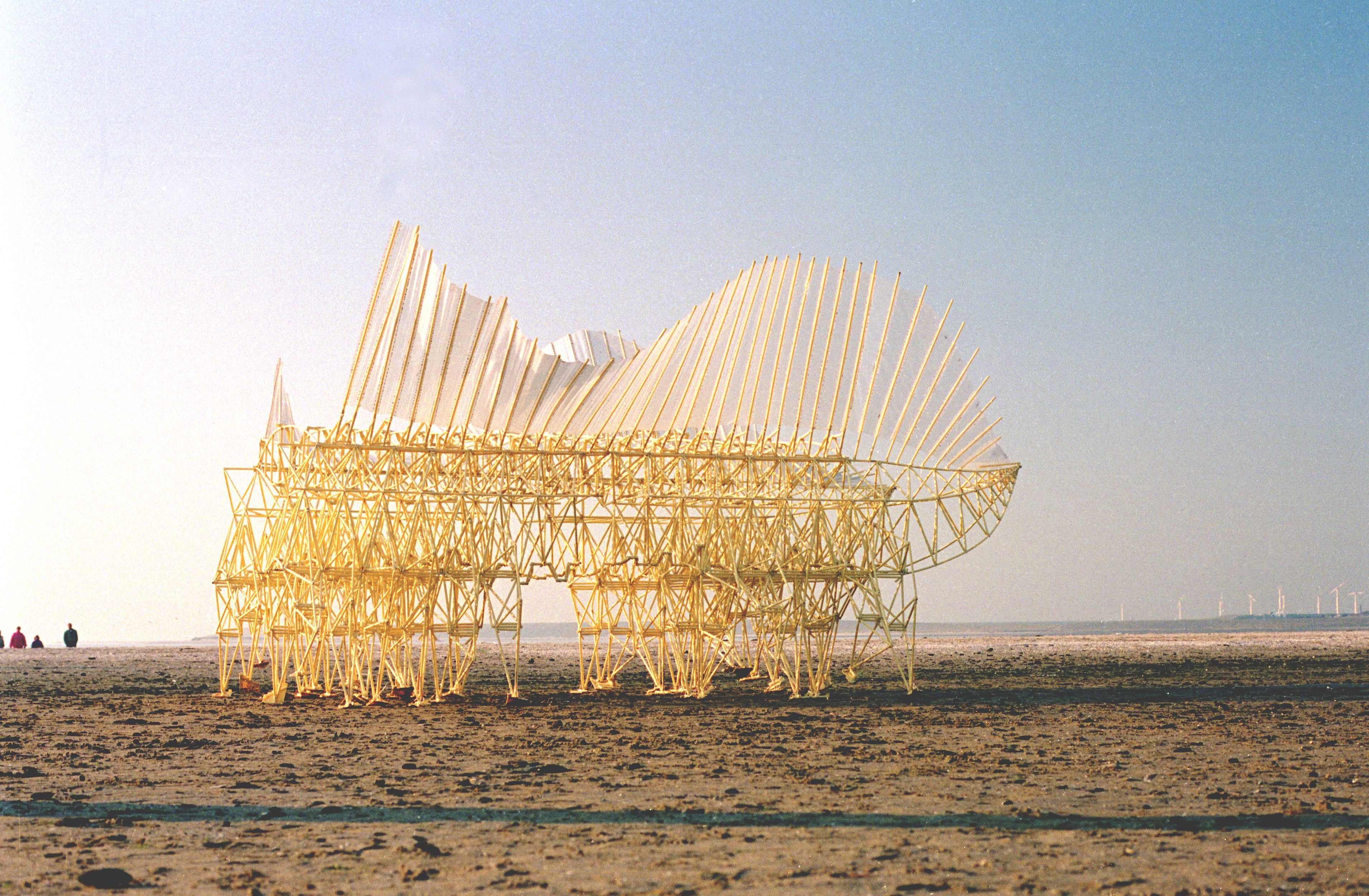
Theo Jansen is a Dutch artist. In 1990, he began building large mechanisms out of PVC that are able to move on their own and, collectively, are entitled, Strandbeest. photo credit
Theo Jansen describes his work as “making new forms of life.” He’s been creating these kinetic sculptures, called Strandbeests (Dutch for “beach beasts”), since 1990. He considers them a new species that inhabits the beaches of Holland. Jansen says: “Surviving is the purpose.” He designs his Strandbeests to survive in their beach environment, powered entirely by wind—no electricity or stored power. Their survival depends on their ability to navigate the challenges of the coastline.
See
The kinetic sculptures appear to walk. His animated works are intended to be a fusion of art and engineering. He has said that “The walls between art and engineering exist only in our minds.” He strives to equip his creations with their own artificial intelligence so they may avoid obstacles, such as the sea, by changing course when detected.
Animaris Modularis 2007
Every spring I go to the beach with a new beast. During the summer I do all kinds of experiments with the wind, sand and water. In the fall I grew a bit wiser about how these beasts can survive the circumstances on the beach. At that point I declare them extinct and they go to the bone yard. -Theo Jansen
From Concept to Fruition- Currens Ventosa
1993 Currens Ventosa
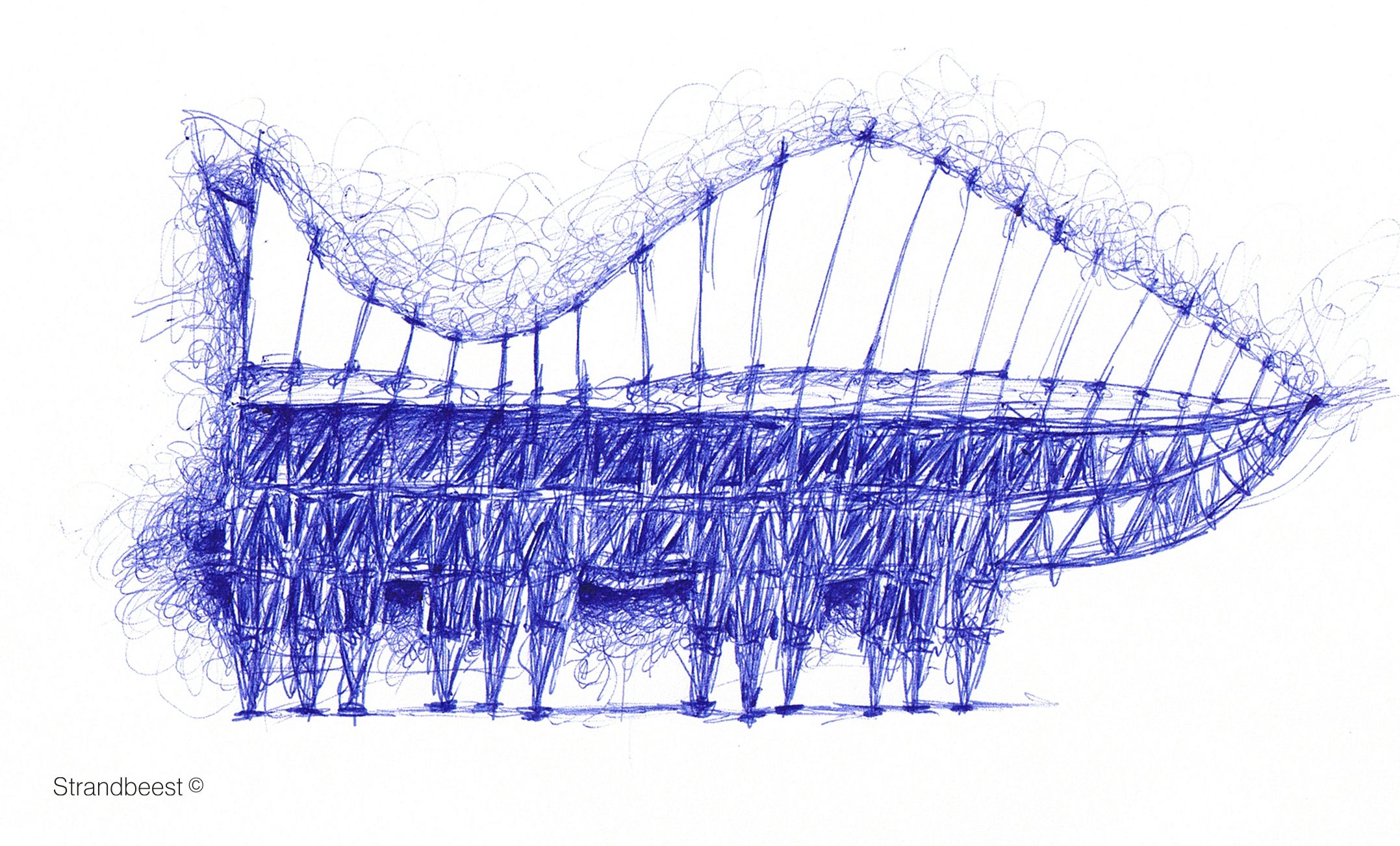
“I always make some sketches before starting to build a new beast.”-Jansen
Jansen’s philosophy embraces evolution through design iteration. He continuously refines his creatures, allowing them to become more sophisticated and better adapted to their environment over time. They’re not just sculptures—they’re evolving mechanical organisms with a purpose: to survive on the beach.
Evolution Map of Standbeests
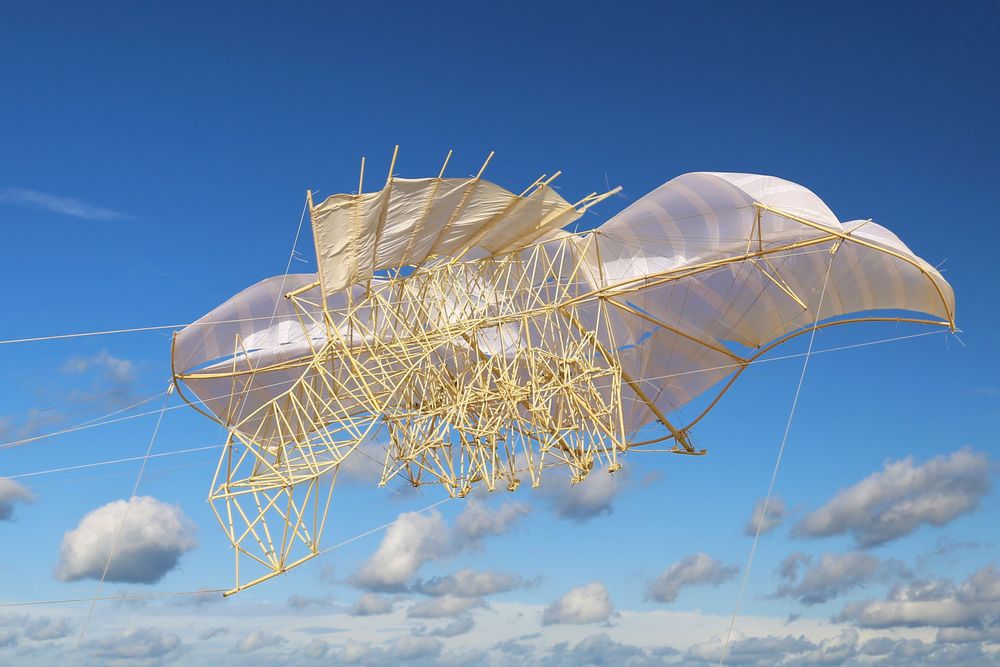
Ader 2020
“Well, the Ader (yes, named after the aviation pioneer) could fly up to six meters high. The sand would just blow underneath, how simple could it be. Two sandbags left and right were supposed to stabilize him. And of course he had to be anchored. A sand body was also created in the Volantum that could screw itself pneumatically into the ground. To be on the safe side, the Ader was anchored to a post on the beach.” Jansen
How do you think it would feel to see a herd of these moving gracefully down a beach?
Do
Create a sketch for a kinetic sculpture.
Build a mobile or other wind powered sculpture using everyday objects.
Can you create one that also makes sound? How?
About Theo Jansen
Theo Jansen, a Dutch artist, sculptor, and engineer, was born Mar. 14, 1948, in Scheveningen, in the Netherlands. Since 1990, Jansen has been fashioning lumbering creatures, made mostly of ordinary PVC pipe, that wander up and down the nearby beaches of the North Sea, driven by the wind. He calls his creations strandbeesten – beach animals. Since sand is not kind to wheeled mechanisms, a strandbeest does not roll along; it rather walks, lifting its many legs like a caterpillar walking sideways. The original strandbeesten were large to start with, the size of small cars, and have grown to the size of dinosaurs over the past 34 years.
One might call Jansen a kinetic artist, or kinetic sculptor, since his creations move. He is also an engineer of considerable talent, since it is not easy to get a PVC walker to stay level while its legs churn up and down. They harness the wind with windmill-like vanes, or sails, or flapping wings. The early strandbeesten simply moved where the wind pushed them, but more recent offspring (all of which bear Latin names, such as Animaris adulari) have sophisticated mechanical mechanisms that will turn them away from the water. Should they wander that way, or even reverse their motion should they run into something. Jansen likes to call this “evolution,” but all the evolving really takes place in Jansen’s creative mind. He is the Intelligent Designer who learns from his mistakes, which is what a really Intelligent Designer ought to do.
Water Mark by Laura Haddad and Tom Drugan is a Scottsdale public art installation of aluminum horses that spend most days dry, then come alive during flash floods on the Indian Bend Wash. When the desert floods, water channels through the horses and pours from their mouths, turning sculpture into functioning infrastructure. Haddad|Drugan designed the…
Justin Bateman creates intricate pebble portraits of Attenborough, Marley, and da Vinci masterpieces from found stones, then scatters them back to nature. His ephemeral land art, built stone by stone over weeks, vanishes once photographed. A meditation on beauty, impermanence, and the creative force behind all living things.
Okuda San Miguel transforms abandoned churches and crumbling walls into rainbow geometric murals on nearly every continent. His Kaos Temple converted a 100-year-old Spanish church into a skate park painted floor to ceiling, with a half pipe where the pews used to be. His Coloring the World Foundation brings community art to schools and vulnerable…
Every Sunday, I send out the Weekly Wonder newsletter featuring art, artists, and activities to spark your sense of wonder and bring inspiration to your week.