

Small Art, Big Wonder
I was recently reading about the Henry Moore show featuring his miniature works, and I became curious about how experiencing miniature art provides us a natural sense of wonder.
Mother and Child, 1930, Henry Moore

This sculpture is 15.3 centimeters (approx. 6 in- smaller than the length of an adult hand). Compare it to the feeling you get from his sculpture below at the Yorkshire Sculpture Park.
You can have a large sculpture which is petty and similarly a small work which has a sort of grand scale. -Henry Moore
Large Two Forms, 1966-1969 Henry Moore

Henry Moore is celebrated for his monumental sculptures in city squares and parks, while the artist’s smaller works can fit into the palm of your hand. It is surprising and intimate to look at his art on a tiny scale! The smaller pieces invite the viewer in for a close up look where one can see every curve and detail, almost like having a quiet conversation with the artist. In contrast, the larger sculpture makes the viewer feel tiny and awestruck, encouraging a walk around it, to see how it changes from every angle. It becomes part of the landscape.
See
Over the next few Sundays, let’s explore some miniature art to explore the idea of wonder through miniature art! Today we will start with artist, by Salavat Fidai, Russian American artist famous for carving detailed sculptures from pencil graphite, wood and other tiny materials like seeds.
Female and Male, 2020 by Salavat Fidai

“Whenever we see tiny things we find cute and attractive, our brain releases dopamine and makes us feel happy.”
We Experience Awe and Wonder
Our brains are often drawn to the unique and unusual. “Miniatures—tiny objects—draw our attention because they are extraordinary; the mind knows that the object is highly unusual in size while being familiar in design,” says Carla Marie Manly, PhD, a clinical psychologist in Sonoma County, California. “Thus, the mind finds the tiny object appealing—cute and adorable—as it evokes a sense of normalcy and oddity at the same time.”
Handshake

How in the World??
Using a craft knife and magnifying glass, he carefully removes graphite to form the image, a process that requires immense patience and precision as the lead is very fragile.
His repertoire includes pop culture figures, animals, architecture, and everyday objects.
Surfer. 2022

The Bird in a Cage, 2017

Watch Carving the Bird in the Cage
There’s also the “awe factor,” or wondering how in the world something that’s usually so big can be made in such a small size. “Seeing a marvel or feat that reminds us how amazing, talented, creative people make us feel good,” says Gail Saltz, MD, a psychiatrist and associate professor of psychiatry at the New York Presbyterian Hospital Weill-Cornell School of Medicine. “Seeing something that makes us use our imagination, and is so original [that] it gives us pleasure can, like art, [be] a creative wonder.”
Two Hearts

Say
It’s fascinating how scale shifts our perspective, mood, and even our connection to the art. In the case of the Henry Moore examples, it is the same artist, the same style—but a completely different experience.
- Have you ever felt your perspective shift while looking at a work of art? Which piece made you feel the biggest—or the smallest?
- Check out a Henry Moore sculpture near you (map), and then imagine it in small scale. How might the scale change the experience?
- Which of the sculptures above are you most amazed by? Why?
- Make a mental list of 10 things that are cuter when they are tiny.
Do
One thing I love to do is create tiny tapestries. So fun, so cute!

- Make a tiny artwork.
- Cut out a stack of 1in x 1in paper. Create mini artworks on them.
- Benefits and Magic of Making Tiny Art
About the Artist: Salavat Fidai
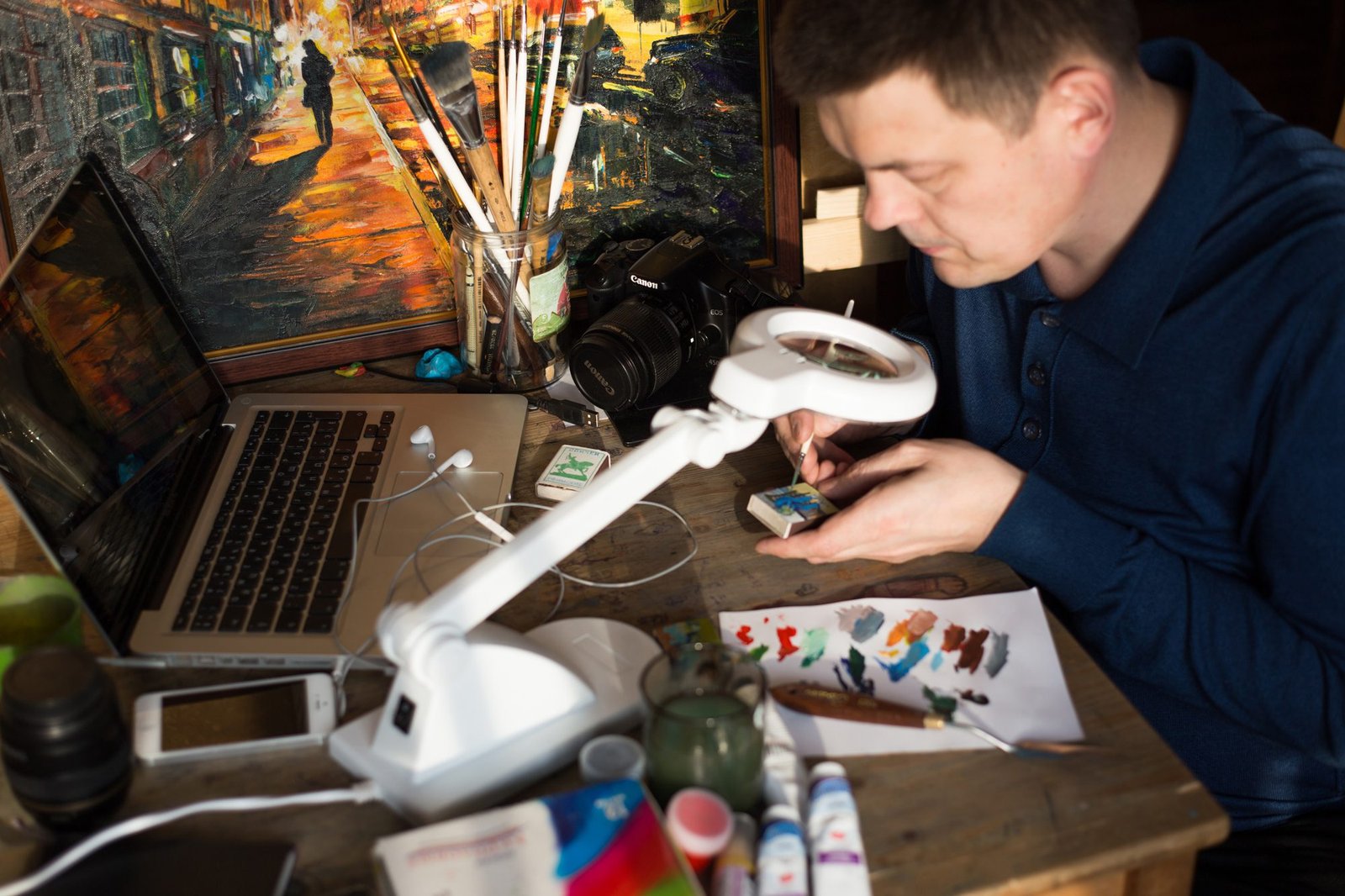
Manifesto
Hi, I’m Salavat Fidai: the artist and sculptor from Charlotte, North Carolina, USA.
My art is a challenge to myself and my abilities. First and foremost, I am interested in exploring the limits of human physical capabilities. Every time I create a sculpture on the tip of a pencil, I explore what else I can make from this very fragile material in such a small size. Can I achieve precision in the depiction, convey its grace, and strive for perfection?
I am also drawn to the uniqueness and extraordinary nature of this form of creativity. Just when it seems that everything has already been invented and discovered, and all that’s left is to follow the established norms, I suddenly discover a completely new form of art. Everyone uses a pencil as a tool. But I made the pencil into a rare piece of art!
Therefore, today, I am inspired by the idea of recognizing graphite micro-sculptures as a new direction in world Art. To move from the realm of craftsmanship or folk art to a place of mainstream Art. To stand alongside sculptures made from other materials like granite, stone, bronze, and etc.
I would like to inspire other artists with this example not to be afraid to experiment and create from various new materials. People can find beauty everywhere, even in ordinary, simple objects.
My big dream is to create a Museum of graphite micro-sculptures. I would like to establish a space for the exhibition and permanent storage of my works and sculptures from other artists around the world. This would be the first institution of its kind and direction.
Follow Fidai – he is always posting videos of his recent works. Because he uses great cameras, these are really fun to watch! Website, Instagram, TikTok


