

1.26 by Janet Echelman

1.26, 2010. Spectra (R) fiber, high-tenacity polyester fiber, and lighting, 230 x 63 x 30 ft. Work installed at Civic Center Park, Denver, CO.
For its first installation, 1.26 was suspended from the roof of the 7-story Denver Art Museum above downtown street traffic to commemorate the inaugural Biennial of the Americas.
The City of Denver asked the artist to create a monumental yet temporary work exploring the theme of the interconnectedness of the 35 nations that make up the Western Hemisphere. She drew inspiration from the NASA Jet Propulsion Laboratory’s announcement that the February 2010 Chile earthquake shortened the length of the earth’s day by 1.26 microseconds by slightly redistributing the earth’s mass. A 3-dimensional form of the tsunami’s amplitude rippling across the Pacific became the basis for the sculptural form. Exploring further, Echelman drew on a National Oceanic and Atmospheric Administration (NOAA) simulation of the earthquake’s ensuing tsunami, using the 3-dimensional form of the tsunami’s amplitude rippling across the Pacific as the basis for her sculptural form.
See
Echelman feels that her sculptures illuminate what is already there and force us to see spaces and wind in new ways.

Bending Arc, St. Petersburg, FL

Janet Echelman’s 1.8 San Diego located in San Diego, CA, 2016 – Photo by: Mattew Echelman
 Breaking Down Boundaries with Art
 Taking Imagination Seriously- Watch to learn how Janet Echelman found her true voice as an artist when her paints went missing…
Say
- What do you think of Echelman’s sculptures?
- How might they reveal something about the human experience?
- Is it important that her work is placed in urban settings? Why or why not?
Do
Think about a time where a mishap has led you to a positive discovery. Echelman has the grant and a deadline to create a series of paintings. She travels to India to work on her paintings but her paints never arrive. Because of this mishap, she discovers the qualities of fish nets and begins using them in sculptures. You just never know!
Create a wind sock, fly a kite, make a pinwheel. Illuminate the wind…it is already there!
About Janet Echelman

BIOGRAPHY quoted from artist website echelman.com
Janet Echelman sculpts at the scale of buildings and city blocks. Echelman’s work defies categorization, as it intersects Sculpture, Architecture, Urban Design, Material Science, Structural & Aeronautical Engineering, and Computer Science. Echelman’s art transforms with wind and light, and shifts from being “an object you look at, into an experience you can get lost in.”
Using unlikely materials from atomized water particles to engineered fiber fifteen times stronger than steel, Echelman combines ancient craft with computational design software to create artworks that have become focal points for urban life on five continents, from Singapore, Sydney, Shanghai, and Santiago, to Beijing, Boston, New York and London. Permanent works in Porto, Vancouver, San Francisco, West Hollywood, Phoenix, Eugene, Greensboro, Philadelphia, and Seattle transform daily with colored light.
Curiosity defines Janet Echelman’s nonlinear educational path. After graduating from Harvard College, she lived in a Balinese village for 5 years, then completed separate graduate programs in Painting and in Psychology. A recipient of an honorary Doctorate from Tufts University, Echelman has taught at MIT, Harvard and Princeton Universities.
Her TED talk “Taking Imagination Seriously” has been translated into 35 languages with more than two million views. Recipient of the Guggenheim Fellowship, Harvard Loeb Fellowship, Aspen Institute Henry Crown Fellowship, and Fulbright Sr. Lectureship, Echelman received the Smithsonian American Ingenuity Award in Visual Arts, honoring “the greatest innovators in America today.” In popular culture, Oprah ranked Echelman’s work #1 on her List of 50 Things That Make You Say Wow!, and Echelman was named an Architectural Digest Innovator for “changing the very essence of urban spaces.”
ARTIST’S STORY
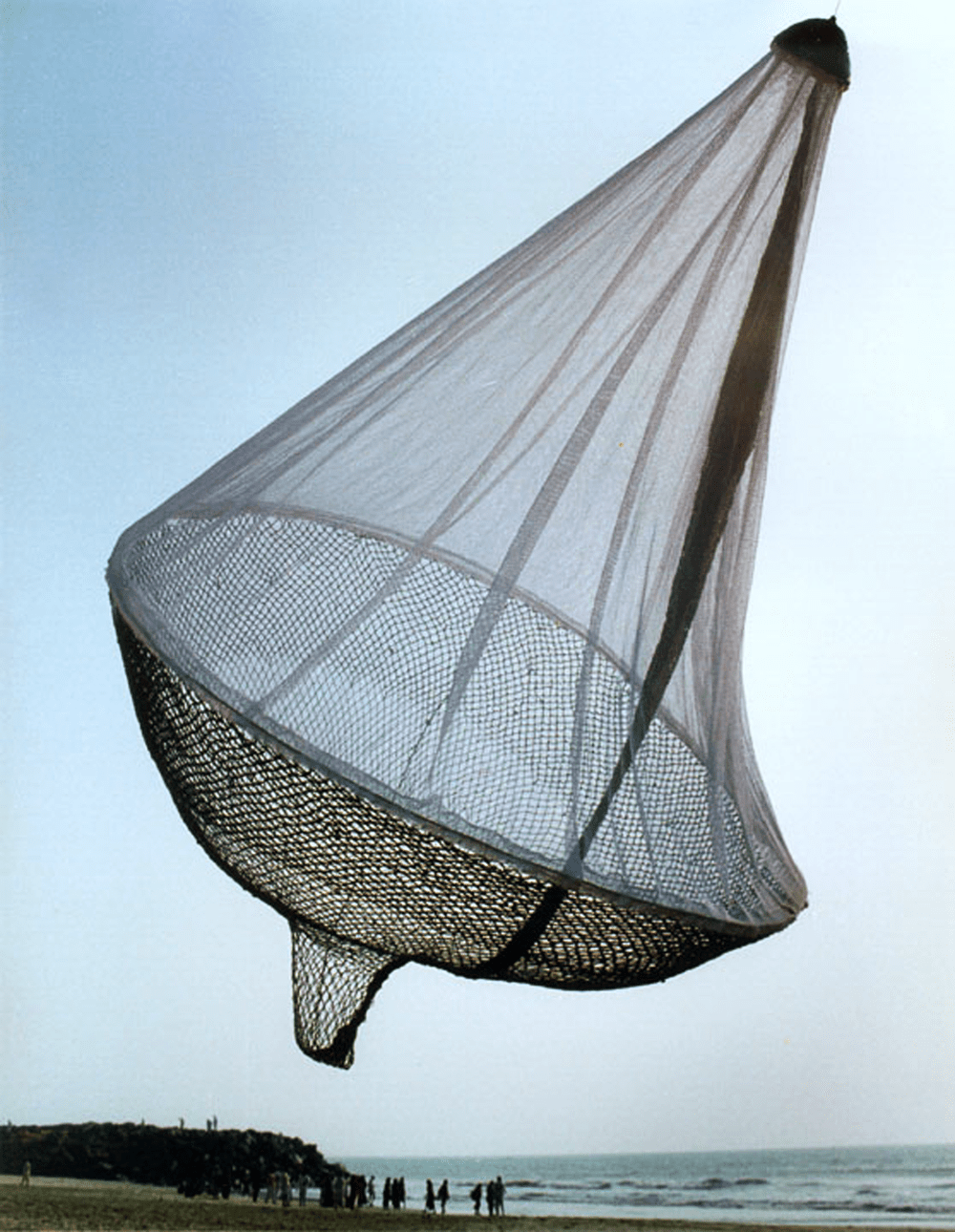
Wide Hips, 1997
Echelman first set out to be an artist after graduating from college. She travelled to Hong Kong in 1987 to study Chinese calligraphy and brush-painting. Later she moved to Bali, Indonesia, where she collaborated with artisans to combine traditional textile methods with contemporary painting.
When she lost her bamboo house in Bali to a fire, Echelman returned to the United States and began teaching at Harvard. After seven years as an Artist-in-Residence, she returned to Asia, embarking on a Fulbright lectureship in India.
Promising to give painting exhibitions around the country on behalf of the US Embassy, Echelman shipped her special paints and equipment to Mahabalipuram, a fishing village famous for sculpture. The deadline for the shows arrived – but her paints did not. Echelman, inspired by the local materials and culture, began working with bronze casters in the village but soon found the material too heavy and expensive.
Echelman walked along the beach daily, watching the fishermen bundling their nets into mounds on the sand. She’d seen it every day, but this time saw it differently – a new approach to sculpture, a way to make volumetric form without heavy, solid materials.
Her first satisfying sculptures were hand-crafted in collaboration with those fishermen. Hoisting them onto poles, she discovered that their delicate surfaces revealed every ripple of wind in constantly changing patterns and she was mesmerized.
Today Echelman constructs net sculpture environments in cities around the world. Echelman’s studio is based in Boston, where she lives with her husband David Feldman and their two children.


