|
Moshe Safdie’s Rain Vortex
|

|
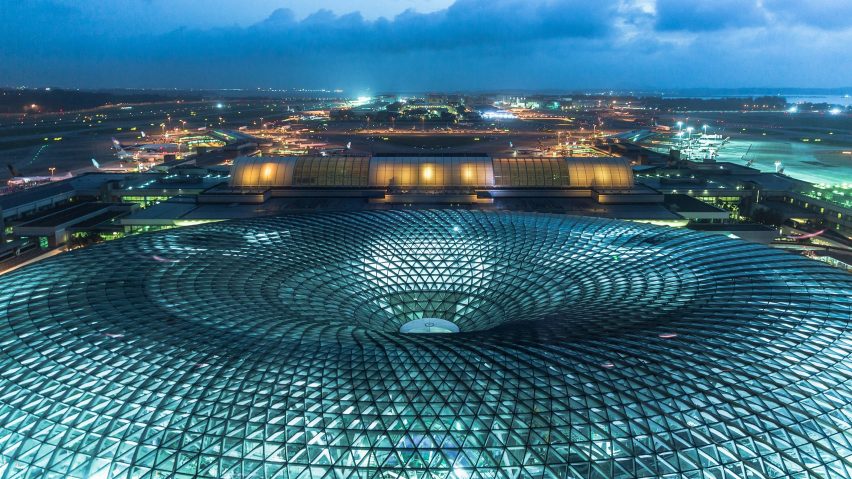
Changi Airport Jewel, Singapore, 2019
“Jewel weaves together an experience of nature and the marketplace, dramatically asserting the idea of the airport as an uplifting and vibrant urban center, engaging travelers, visitors and residents, and echoing Singapore’s reputation as ‘The City in the Garden’.” -Moshe Safdie
Rain Vortex at night |

|
What makes the Rain Vortex truly special isn’t just its record-breaking height-it’s how it transforms the typically sterile airport environment into a place of wonder. Visitors consistently describe feeling amazed, mesmerized, and transported by this fusion of architecture, nature, and technology. This is Moshe Safdie’s vision realized: architecture that doesn’t just function, but inspires, creating moments of pause and beauty in our everyday journeys. SeeImagine walking through an airport and being greeted by the world’s tallest indoor waterfall cascading 130 feet (ca. 40 m) from the ceiling in a mesmerizing spiral. This isn’t a dream—it’s the breathtaking Rain Vortex at Singapore’s Changi Airport Jewel, designed by renowned architect Moshe Safdie. “You forget you’re in a building” — Safte describing how the Rain Vortex creates an almost outdoor experience indoors.
Safdie, the visionary behind iconic structures like Marina Bay Sands, has once again proven that functional spaces can be transformative art experiences. The Rain Vortex isn’t just a fountain; it’s a living sculpture that changes throughout the day. During daylight hours, natural light dances through the water, creating ever-shifting patterns. At night, it becomes a canvas for spectacular light shows that turn the entire space into an immersive wonderland. Great architecture doesn’t just shelter us; it inspires us.
The exterior of the Vortex looks like a giant glass bagel. Problem solved with beauty and ingenuity! Singapore experiences frequent thunderstorms, so the Rain Vortex has been designed to funnel rainwater at a rate of 10,000 gallons (ca. 38 m³) per minute. This stream of water will naturally cool the air under the dome, with the captured water will be re-used in the building. (Dezeen) The Rain Vortex reminds us that public spaces can be galleries, and that art has the power to turn ordinary moments into extraordinary memories.
There’s a topiary garden and an area called Foggy Bowls. It’s a playground and relaxation area where occasional puffs of mist rise out of the bowls, giving the impression that you are up in the clouds. (Read about other fun features in this The Boston Globe article)
As an architect he uses light and water to try to achieve what music achieves with rhythm and melody. The nature of his work often requires turning symbolism into structure. Check out these other amazing structures. Be sure to follow links to learn more!
The United States Institute of Peace is meant to reflect the flight of a dove.
The Artscience Museum located along the Marina Bay Sands waterfront co-locates exhibits that bridge the relationship between Arts and Sciences. The museum is organized as two major exhibition spaces, positioned around a central open-space atrium. The first exhibits hover within a sculpturally shaped form over the promenade, and a second collection of gallery spaces are located beneath a large water lily garden.
The Habitat ’67 housing complex on the St. Lawrence River in Montreal, which was designed by Moshe Safdie for the Expo 67 world fair. Habitat ’67 was a prefabricated concrete housing complex comprising three clusters of individual apartment units arranged like irregularly stacked blocks along a zigzagged framework. This bold experiment in prefabricated housing using modular units aroused intense international interest at the time, though it did not inaugurate a trend toward the mass production of such low-cost units. When Safdie designed this project for his master’s thesis as an architecture student at McGill University he was just 24 and had never built a building before! Say
Discussion Starters:
Do
About the Artist: Moshe Safdie
Born: July 14, 1938, Haifa, Palestine [now in Israel] (age 86)
|