

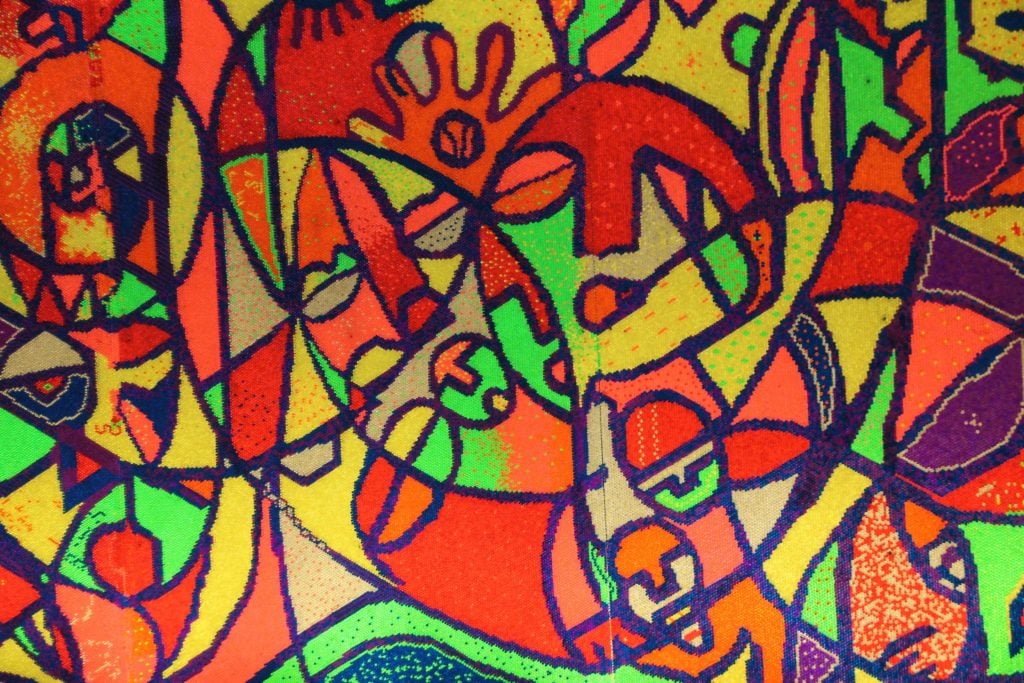
Ta-coumba Tyrone Aiken is a painter and public artist who identifies his work as superlative realism. He has created over 600 murals and public art works. A mural Aiken designed in 2013 using over 596,000 Lite Brite pegs holds the Guinness World Record for the largest picture made of Lite Brite.
See
Ta-coumba Tyrone Aiken’s Lite Brite mural is more than just a vibrant visual—it’s a beacon of positivity and playfulness for everyone who encounters it. By drawing inspiration from the classic Lite-Brite toy, Aiken taps into a sense of nostalgia that bridges generations. The mural’s glowing, colorful dots recall childhood memories of creating glowing designs in the dark, reminding us of the simple magic of play.
 |
But Aiken doesn’t just reference the toy; he transforms it into a tool for connection. By inviting community members to participate—placing their own “lights” onto the mural—he turns public art into a shared experience. The familiar toy becomes a symbol of collective imagination, where everyone’s contribution matters and the final piece is brighter because of it. This approach evokes a positive spirit in several ways:
- Nostalgia as Joy: The mural brings back fond memories, sparking smiles and conversations among people of all ages.
- Inclusivity: Like the toy, the project is intuitive and accessible, making everyone feel welcome to join in. The mural is made of more than 596,000 Lite Brite pegs, and more than 600 volunteers helped put it together.
- Celebration of Light: In both a literal and metaphorical sense, the mural radiates hope, warmth, and the idea that together, we can light up our community.
 |
Aiken’s Lite Brite mural reminds us that art can be playful and profound at once—illuminating not just walls, but the hearts of all who take part.

 |
 |
Say
— Ta-coumba Aiken
- How does the Lite Brite Mural evoke a positive spirit? What elements of art (line, shape, color) help to create that positive spirit?
- I feel I have lived several lifetimes, and watching the lite bright commercial (below) from my childhood thrusts me into the past…purple plaid pants and all! What from your past sends you back to another time?
Do
- Visit The Union Depot in St. Paul, MN to visit the Forever St. Paul Lite Brite mural. The last time I visited, there were families and couples of every demographic together enjoying the festivities. It is definitely a welcoming community hub.
- Try to find Sparky the Seal (an ‘immortal’ St. Paul icon who continues to entertain crowds at the Como Park Zoo.)
- Choose a favorite toy from your childhood (or something simple like building blocks, marbles, or even a Lite-Brite). Use it as inspiration for an artwork, or even incorporate the toy itself into your creation. Reflect on how using something familiar and accessible can break down barriers, and spark joy!
About the Artist: Ta-coumba Aiken
 |
Tyrone Aiken was born on December 29, 1952, in Evanston, Illinois. His mother was a healer and worked as a house cleaner. His father worked as a garbage man and brought home damaged paint sets for his son from stores that had thrown them in the trash. Aiken’s parents changed his name when he was nine at his grandmother’s discretion. They were religious and emphasized community, including keeping a separate freezer for food for anyone who needed it. His mother died on his 20th birthday, and he views part of his work as carrying on her legacy of healing.
At the age of three, he was interested in painting, and by age six, he did an exhibit in his childhood home’s basement. While in high school in Evanston, he attended the International Design Conference in Aspen, Colorado. He came to Minneapolis at the age of 16 for art school and graduated from the Minneapolis College of Art and Design with a Bachelor of Fine Arts degree in 1974. He initially intended to head for Madison’s art scene but got lost and stopped to buy gas in Eau Claire, Wisconsin, where he asked where the nearest town was with more black people. The gas station employee told him to go to Minneapolis. He worked at Honeywell in Minneapolis as an illustrator.
Aiken is the force behind some of Minnesota’s most acclaimed public artworks. Since the early 1970s, he has created public art in collaboration with schools, neighborhood organizations, and city planning and development departments on many works.
- The Jax / Gillette Children’s Hospital mural
- The Minneapolis Central Library’s fourth floor fireplace
- Seventh and Robert Street Municipal parking ramp
- The Good Thunder Grain Elevator
- North Side’s Pilot City murals project
He supports the use of his artwork by organizations involved in pursuing social justice.
As an artist who has worked in the public sphere, Aiken has learned how to identify opportunities that exist in architectural, landscape and public works projects. He works in a wide range of glass, metal, clay, wood, and landscaping materials, and some of his recent public art projects with painted glazes on large ceramic installations have given his mural work new permanence.
Inspired by his mother at a young age, his first canvases already showed an eye-catching style and an advanced command of lines. Then, when an accident at age 11 impaired his perception of colors, the young artist turned to paint pens and ink, opting to paint directly from the bottles when having problems seeing colors. Today, the variety of tone and contrasting colors in his work has become a hallmark of Aiken’s eye-catching style and perspective. Working from black and white outlines, he describes his process of coloration and shape building as “spirit writing” and his usage of repeating imagery as “rhythm patterns.”
Aiken helped to open Lowertown Lofts so he could live and work in the same place.
Visit tacoumbaaiken to see other public art works by Aiken.





