


Gustav Vigeland was one of the most prolific sculptors of all time. Rather than idealizing the human form with flawless anatomy as in the Classical period of Ancient Greece and the Renaissance, Gustav Vigeland’s sculptures represent people with human experience, rendered neither in shame or glorification.
See
While walking through Vigeland park in Oslo, Norway on a recent trip, I was struck by the profound feeling I had while looking at all of the sculptures representing the real lives of people. I felt represented and seen. His pieces, though stylized, were reflective of the real human form, not aspirational. Have a look at the images below and see how they make you feel.

Walking among these sculptures felt a bit voyeuristic. The people were so natural and unposed. Vigeland’s figures are old men with sagging skin, infants mid-tantrum, couples in mid-argument, elderly women folding into grief. His bodies show exhaustion, tenderness, fury, longing, and absurdity – often all at once. There is no pedestal of idealization. These are bodies that live.


Vigeland worked in stone and bronze. The bridge leading into the main sculpture collection is lined with bronze sculptures representing the many relationships and emotions of life.
His most famous single work, Sinnataggen (“The Angry Boy”), shows a toddler in full meltdown – fists clenched, face contorted in rage. It is beloved precisely because it is utterly, recognizably human. (The bronze on his left hand has been rubbed gold by visitors for decades – a kind of irreverent pilgrimage.)

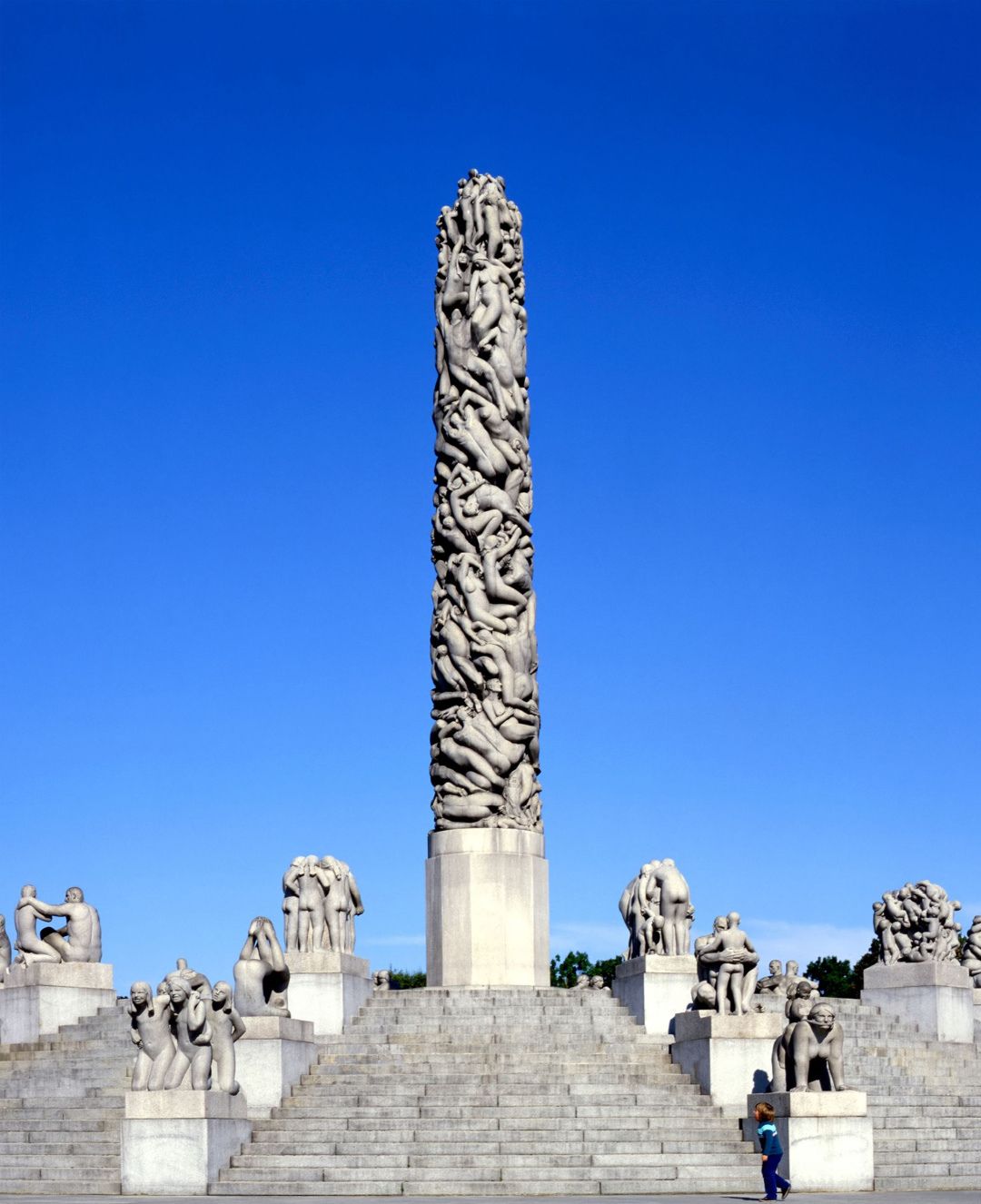
The Monolith, a 14-meter granite column carved with 121 intertwined human figures climbing over and around each other, is simultaneously terrifying and beautiful – a meditation on mortality, struggle, and the human drive to rise. Vigeland worked on it for decades.
Say
Vigeland was working at the same time as the European modernists – Picasso was fragmenting the body, the Expressionists were distorting it for emotional effect. But Vigeland’s radicalism was quieter and, in some ways, more profound: he insisted on wholeness. Full human beings, in full human experience, unsettling and honest.
In a tradition that had spent 2,000 years asking what the body could aspire to, Vigeland simply asked: what is the body actually like?
- Why do you think it his work resonates with so many people from around the world?
- Which of the sculptures above captured your attention? Why?
- Which type of human sculptures do you prefer? Realistic, Idealistic or Expressionistic?
Do
- Visit Vigeland Sculpture Park – It is free, open year-round, and visited by over a million people annually. It remains the most visited attraction in Norway. The sculpture park is Gustav Vigeland’s life’s work, and consists of over 200 sculptures in granite, bronze and wrought iron. It was built mainly in the period 1940-1949, but is the result of over 40 years of work.
- Go to a museum this summer and look at some sculptures of people. What is the purpose of the way they are represented? How can you tell?
- Find one that resonates with you, sketch it.
About the Artist: Gustav Vigeland

Gustav Vigeland (1869-1943) was Norway’s most celebrated sculptor – and arguably one of the most audacious artists of the 20th century. Born into poverty in the small coastal town of Mandal, he taught himself to carve wood as a boy before eventually apprenticing with a cabinetmaker in Oslo. His talent was undeniable, but his path was anything but smooth.
As a young man, Vigeland was so destitute that friends and patrons had to fundraise just to keep him from starving. He traveled to Paris, Florence, and Berlin, absorbing Rodin’s expressive modeling, medieval Gothic sculpture, and Renaissance mastery – yet he ultimately rejected all of it in favor of something far more unsettling and honest.
The Deal of a Lifetime- In 1921, Vigeland struck one of the most extraordinary deals in art history. The city of Oslo offered him a free studio and lifetime housing – in exchange for everything he ever created. Every sketch, every model, every finished work would belong to the city upon his death.
Vigeland accepted without hesitation and spent the rest of his life on a single obsessive project: Vigeland Sculpture Park in Frogner Park, Oslo. It remains the world’s largest sculpture park made by a single artist – 212 bronze and granite sculptures with over 650 figures, all conceived, designed, and largely executed by Vigeland himself.
He never left Oslo again.


