

|
Standing Glass Fish |
|

|
My introduction to Frank Gehry was at the Walker Art Center in Minneapolis. I lived just across Loring Park from the museum and witnessed the installation of the Sculpture Garden in 1988. Anchoring the west side of the Garden was the Cowles Conservatory, which housed seasonal plantings and the sculpture Standing Glass Fish, by architect Frank Gehry. This was a winter destination for me during my college years. It was always humid and filled with palms, ferns, and succulents. Gehry’s Fish was a massive presence in the conservatory. No surprise, fish were very significant to Gehry as well. He told a story about he and his grandmother buying a large, live carp on Thursdays. She would fill her bathtub, and it would swim circles in her bathtub until she made it into gefelte fish. It turns out watching this giant fish in Grandma’s tub as a child had a profound influence on Gehry. Eventually, Minneapolis Parks decided to redesign the conservatory due to infrastructure issues and “Standing Glass Fish” was moved to the Weisman Art Museum (Designed by Gehry himself) at the University of MN in 2015. SeeGehry’s Signature Style uses unexpected materials (like corrugated metal and chain-link) and playful shapes to challenge our expectations of what buildings can be. Gehry’s designs are about breaking boundaries and sparking emotion. The fish motif is found in many of Gehry’s projects since the early 1980’s. Let’s look at some other fish sculptures and lamps, then at some of his architecture to see the influence of fish! Swooping curves, Shimmering metal, and forms that look as if they’re in motion
|
 |
El Peix is made from gilded stainless steel strips, metal structure, stone, and glass. It is approximately 35 meters (114 feet) high and 54-56 meters (180 feet) long.
This sculpture has become one of the symbols of post-Olympic Barcelona and looks as if it is bobbing along on the waters of the Mediterranean. The sunlight is reflected in the scales of this sculpture that presides over the waterfront of the Olympic Marina and Barcelona’s beaches.
The sculpture was made from intertwining gilded stainless steel strips supported by a metal structure, its gentle, subtle form marked by its intense gold colour. The interplay between the rays of the sun and skin creates the impression of scales, depending on the intensity of the light, and accentuates the organic form of this vast sculpture. The Fish sculpture can be seen from Barceloneta Beach and the Olympic Marina, and has become one of the city’s best-loved iconic landmarks. (Barcelona Experience)
He views the fish as a “perfect form” that expresses movement and fluidity, which he sought to translate into his static sculptures and architecture.
Fish Dance Sculpture, 1987, Kobe, Japan
 |
The giant fish sculpture is approximately 22 meters (72 feet) tall and made of a steel frame covered with chain-link mesh and copper plates that resemble scales.
Fish Dance was an important early example of Gehry’s use of computer-aided design to realize complex, curved forms that would become his signature style, famously seen later in buildings like Minneapolis’ own Weisman Art Museum.
Fish Themed Lamps
In January of 2013 Gehry unveiled this striking series of fish lamps at Gagosian Beverly Hills and later in Paris and Hong Kong. The glowing fish are constructed from jagged scales of ColorCore formica mounted on a wireframe and are an extension of a series of similar lights first built between 1984 and 1986. The story goes that while working on a commission for Formica back in the 80s Gehry dropped a piece of ColorCore which shattered, inspiring the idea of fish scales. (ThisIsColassal)
 |
 |
 |
Architecture
Gehry’s architecture often reflects the dual curves of the fish motifs.
The Weisman Art Museum
 |
Weisman Art Museum, Minneapolis: Gehry’s silver-clad Weisman Art Museum on the University of Minnesota campus is a local icon. Its twisting, reflective surfaces echo the movement of the nearby Mississippi River and invite visitors to see art—and architecture—from new angles. It’s a perfect example of Gehry’s ability to blend a building with its environment while creating a sense of wonder. The building presents two faces, depending on which side it is viewed from. To the south and east, it presents a brick facade that blends with the historic buildings along Northrop Mall. To the north and west, it is an abstraction of a fish and waterfall in curving and angular brushed steel sheets.
Guggenheim Bilbao
 |
The Guggenheim Bilbao opened to the public in 1997. The reception to Gehry’s unorthodox design was nothing less than ecstatic, drawing international acclaim from fellow architects and critics, as well as from tourists who throng here from throughout the world. Herbert Muschamp, The New York Times architecture critic called the undulating structure a “miracle.” The benefit to the city’s local economy was immediate and substantial and numerous cities have tried (but not always succeeded) to match its success, commissioning similarly dynamic structures from high-profile “starchitects.” (Smarthistory)
Walt Disney Concert Hall
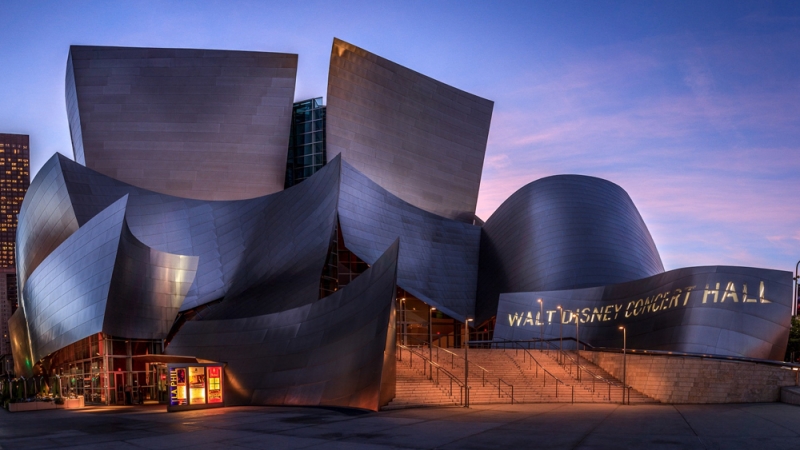 |
In 1991, Gehry designed the Walt Disney Concert Hall complex in Los Angeles, which soon became a cultural landmark in the city. The project had been commissioned by Lillian Disney, widow of the famous Walt Disney. Ms. Disney was particularly fond of roses, and she personally chose the design because the project reminded her of a rose barely opening its petals.
The complex was designed by Gehry as a group of concave and convex sails that intersect as if caught in a windstorm. The exterior of the structure is clad in polished stainless steel and Gehry imagined being on the sailboat with the sails catching wind, “it’s wing-on-wing, it’s the two sails, and you’re at the helm.”
Say
Gehry reminds us that creativity isn’t about following the rules—it’s about imagining new possibilities and bringing them to life.
- How will you bend the rules in your own creative journey this week?
- Do you have an experience from your childhood that has shaped your career? What was it, who was with you?
Do
Experience Gehry’s Artful Spaces
- Visit a Gehry creation and sketch its shapes from different perspectives. How does it change as you move around it?
- Explore photos of Gehry’s other works—notice how do they interact with their surroundings. What emotions do they spark?
- Try designing a building using only unexpected materials you find at home. How can you make something ordinary feel extraordinary?
- Watch Interview with Gehry from 2002.

About the Artist
Frank Gehry- architect, born 28 February 1929; died 5 December 2025
 |
Frank Gehry is the architect who turned the world of design upside down. Known for his bold, sculptural buildings that seem to defy gravity, Gehry’s work invites us to see architecture not just as shelter, but as art that shapes how we experience the world.
Full Obituary in The Gaurdian where he is described as a “rumpled everyman”.
More than any other architect of his generation, Gehry amplified the role of architecture as a brand.





