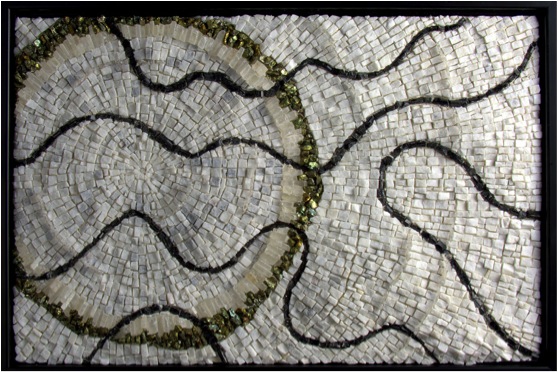
Agate Slices, Fossilized Corral, Native Copper, Lepidolite, Purpurite, Purple Fluorite, Carnelian, Yellow Jasper, Fancy Jasper, Calcite, Fluorite with Chalcopyrite, Honey Quartz, Green Chinese Turquoise, Barite, Vanadinite, Yellow Fluorite, Amethyst, Tiger’s Eye, Mookaite, Black Agate, Sandstone, Petrified Wood , 18” x 18”
Talkov’s mosaics aren’t made from ordinary tiles. She works with minerals, gems, marble, granite, and stones collected from riverbeds around the world. Each piece tells a story of relationships—how one fragment of ruby fuchsite relates to a titanium point, how amethyst shimmers with malachite, how the natural richness of the earth becomes art.
See
Imagine cracking open a stone and discovering a hidden world of color, texture, and light. For mosaic artist Carol Talkov, this moment of wonder happens every single day in her Virginia studio.
“My art is an extension of my passion and fascination with nature.”-Talkov
Talkov’s Seasons ’24 series is particularly beautiful to me as a midwesterner and nature lover who fully experiences seasons.
The materials I use are considered by some as unconventional in the medium of mosaic. Though minerals and stone have been used for centuries, the assemblage and incorporation of these materials in their natural formation are uniquely my own interpretation in a modern translation of an ancient tradition. -Talkov
What’s Inside?
Mosaic Sculpture
17″ x 14″ x 7″
In “What’s Inside?” the tesserae are emphasizing the form with a series of three andamento spirals of travertine limestone. The spiked sea urchin legs create a halo accentuating the form. The snakiing lines in “Wired” (below) remind me of the one in “What’s inside”.
Wired
The variety in her work shows her immense capabilities. Look at the amazing colors in the pieces below. I feel like the day starts so full of hope and developes as a real day might with colors intensifying and fading again with the onset of night. I wonder if the pink Phosphosiderite anchors the night with hope?
Morning
Phosphosiderite, Amazonite, Devalite, Grape Agate, Verde Boutani Forest Stone, Brucite, Fire Opal, Bumble Bee Jasper, Rose Quartz, Amethyst, Polychrome Jasper, 8’“ x 8”
Noon
Lapis Lazul, Agate, Citrine, Calcite, Dendritic, Fancy Jasper, Opals, Green Chinese Turquoise, Corral, Cobalto, Chalcedony Calcite with, Rodocrosite, Mookaite, Limestone, 8” x 8”
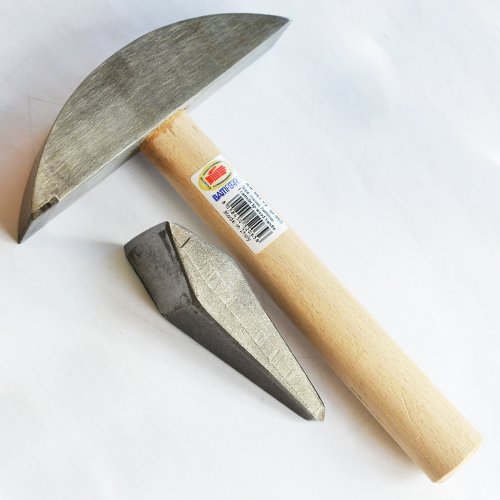
Her work bridges ancient tradition and contemporary expression. After traveling to Italy to study traditional Roman and Byzantine mosaic techniques, Carol learned to cut stone using a hammer and hardie—the same method used for over 2,000 years. But instead of recreating historical patterns, she creates intimate, abstract compositions that invite you to lean in close and experience the energy radiating from each carefully placed piece.
The hardie is a steel chisel blade that is typically fixed upright into a heavy log to act as a fulcrum for cutting.
What speaks to me most is her process. Carol doesn’t begin with a fixed narrative. Instead, she forms a “nucleus” with anchor pieces that intrigue her, then collects other materials that relate. As she experiments with contrast, balance, and flow, the journey itself becomes the story. She describes her piece “In the Beginning” as feeling like “an explosion propelling outward”—each element has singular energy, but grouped together, they become powerful.
In the Beginning
16″x16″
This is the creative process at its finest: trusting the materials, following curiosity, and allowing meaning to emerge through the work itself.
What makes Carol’s journey even more remarkable? She spent her first career as a costume pattern maker for Broadway, opera, dance, and film. For ten years in New York City, she interpreted designers’ sketches and assembled fabrics to create theatrical magic. Then she moved into interior design manufacturing, again putting pieces together to bring visions to life.
The dressform mosaic (left) called The Snake Charmer was in her garden for ten years and need of repair. After removing the tesserea she decided she liked how it still gave the impression of a mosaic. She decided to paint it and keep it indoors.
Now, in her studio, a dress form that once belonged to Elizabeth Taylor stands as a companion—a reminder of where she’s been and how all those years of assembling pieces prepared her for this moment.
Say
Carol Talkov’s work reminds us that transformation isn’t about abandoning who we’ve been—it’s about recognizing how every piece we’ve gathered prepares us for what comes next. Whether you’re working with stones, fabric, words, or ideas, the art is in the assembly.
What pieces of your life are you still putting together? (professionally, personally, spiritually)
What would happen if you trusted the process instead of forcing the narrative?
She feels that working small is important for her and wants viewers to have an intimate experience with it.
What feeling do you experience when studying the stones in
Talkov’s work?
This week, explore the art of assembly in your own life:
Collect your “anchor pieces.” What skills, experiences, or interests have shaped your journey? Write them down. Like Talkov’s ruby fuchsite or titanium points, these are the elements that ground your story.
Look for hidden beauty. Take a walk and collect 3-5 small stones, leaves, or natural objects. When you get home, arrange them in different patterns. Notice how their relationships change based on placement. What “narrative” emerges?
Crack something open. This can be literal (open a geode or walnut) or metaphorical (revisit an old project, journal, or idea you’ve set aside). What hidden colors or textures do you discover?
Create a “relationship” composition. Using any materials you have—paper scraps, fabric, photos, natural objects—create a small collage or arrangement. Don’t plan it. Start with one piece that intrigues you, then add elements that relate. Let the process guide you.
Visit Carol’s work. Explore her website at caroltalkov.com to see her “Silk” and “Tweed” series, along with her sculptural pieces. Notice how she uses andamento (the flow of tesserae) to create movement and energy.
Growing up in Newton Massachusetts and educated at Boston’s Emerson College and Brandeis University where I studied theatrical design. I continued on to New York City to work at a professional level, manufacturing costumes for theater, dance, opera and film in the 1970’s.
A successful business owner since 1983 I operated the well-regarded Carol Studios Inc., an interior designer’s workroom for 27 years in the Washington, DC metropolitan area. My nuanced use of fabric and artistic sensibility made me a sought-after design partner and consultant internationally. Carol Studios work has been shown in House Beautiful, Southern Accents, and Architectural Digest, among others.
Since 2003 I have enhanced my mosaic skills studying at prestigious schools and studios in Italy: Orsoni Mosaic School (Venice), Koko Mosaico Studio (Ravenna), and La Scuola Mosaicisti del Friuli (Spilimbergo).
Carol also champions mosaic art’s place in the contemporary art world. While mosaics are one of the oldest art forms, they’re often misunderstood today—associated only with architecture or craft projects. By creating intimate, fine art pieces and sharing her work, Carol helps re-educate viewers to see mosaics as a legitimate contemporary medium.
Seattle artist Peregrine Church uses hydrophobic spray and stencils to create Rainworks – sidewalk art that stays invisible until rain reveals it. His public installations have spread across multiple continents, bringing surprise and joy to strangers on gray days. See, Say, and Do activities inspired by this ingenious approach to public art.
Water Mark by Laura Haddad and Tom Drugan is a Scottsdale public art installation of aluminum horses that spend most days dry, then come alive during flash floods on the Indian Bend Wash. When the desert floods, water channels through the horses and pours from their mouths, turning sculpture into functioning infrastructure. Haddad|Drugan designed the…
Justin Bateman creates intricate pebble portraits of Attenborough, Marley, and da Vinci masterpieces from found stones, then scatters them back to nature. His ephemeral land art, built stone by stone over weeks, vanishes once photographed. A meditation on beauty, impermanence, and the creative force behind all living things.
Every Sunday, I send out the Weekly Wonder newsletter featuring art, artists, and activities to spark your sense of wonder and bring inspiration to your week.